
Out now: New work on Europe's trade power and the race against deindustrialisation
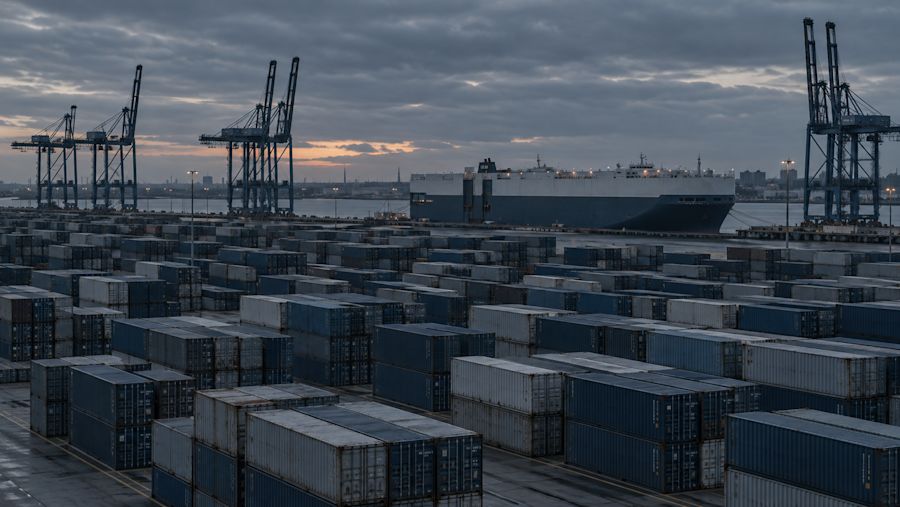
Germany alone loses some 10,000 industrial jobs every month. Chinese overcapacity and Donald Trump's tariffs are accelerating a decline that is largely home-made. In a commentary, a policy brief and a magazine article, I argue that Europe's trade toolbox is sharp enough – what Europe lacks is the willingness to use it.
Read the EUISS commentary here, the full GPPi policy brief here and my article in Internationale Politik here (in German) and its English translation here.
Deindustrialisation in Europe is no longer a forecast. It is an unfolding reality. Most of the damage is self-inflicted: high energy prices, poor infrastructure, overregulation and too little private investment in future technologies. But two external shocks are accelerating the decline. Heavy state support combined with weak domestic demand pushes Chinese firms to export their overcapacities, distorting prices and undermining European competitors. And the deliberately erratic use of tariffs by the US administration has hit the European economy hard.
Europe's reflex is to take trade disputes to the World Trade Organization. That door is now largely shut. Washington has paralysed the Appellate Body and can appeal 'into the void', leaving any ruling against it unenforceable. With China, the EU still has a functioning appeal stage through the MPIA. But litigation takes years, and overcapacity can hollow out a sector in a fraction of that time.
Europe holds more cards than it plays
Beijing relies on exports more than ever. The EU absorbs slightly below 15 % of Chinese exports – but Europe is not merely a large market, it is a premium one. For the same goods, Chinese firms charge European buyers on average around two and a half times what they earn in the rest of the world. Before the EU imposed its tariffs, BYD made close to 13,000 euros on a 'Seal U' sold in Europe and barely 1,300 euros on the same car at home. For a growing number of Chinese manufacturers, access to affluent foreign markets is the difference between profit and loss.
Safeguards: the instrument Berlin is looking for already exists
In July 2026 the German government called for faster and sector-wide anti-dumping and anti-subsidy measures at European level. Coming from a government that voted against the tariffs on Chinese electric vehicles as recently as 2024, this is a genuine turning point. The signal is welcome – the choice of instrument is not. Anti-dumping cases require painstaking, company-specific calculations and work product by product. Safeguards deliver exactly what Berlin is after: they are WTO-compliant, much faster, and can cover an entire sector at once, as the 2018 steel safeguard did across some two dozen product categories. Berlin has found the right instinct. Now it should choose the right tool.
Reform what exists instead of inventing something new
Copying the sweeping powers of US trade law would not give Europe more legal firepower. What makes those instruments formidable is not what they lawfully permit but that Washington disregards international law – precisely the element Europe must not adopt. The EU's own toolkit, from the Foreign Subsidies Regulation to the International Procurement Instrument and the Anti-Coercion Instrument, is impressive on paper. The problem is not capability but credibility. Two gaps undermine deterrence: an activation gap, because measures require a qualified majority among 27 Member States, and a discretion gap, because EU law tightly constrains how and for how long measures may be applied.
Four reforms would narrow the activation gap:
Broaden permanent import monitoring and test whether WTO safeguard rules leave room to backdate duties.
Allow rapid provisional duties, refundable if an investigation collapses.
Flip the voting rule for safeguards and the Anti-Coercion Instrument so that measures take effect unless a qualified majority objects.
Build a solidarity mechanism that shares the cost of retaliation, so that no Member State can be singled out.
To narrow the discretion gap, trade defence measures should work like dials rather than switches, easing automatically as the other side reduces subsidies or opens its markets. The EU should also stop tying its own hands through the lesser-duty rule, and build in automatic escalation powers so that the Commission can answer counter-retaliation without returning to the Council at every step.
The goal is negotiation, not confrontation
None of this serves confrontation. The point is to bring Beijing and Washington to serious negotiations. The channels exist: in June, Commissioner Maroš Šefčovič and Commerce Minister Wang Wentao agreed a new ministerial platform on trade rebalancing, export controls and WTO reform. Procedural progress is welcome, but it is not a breakthrough. Bargaining power only emerges when the other side knows that failure carries a cost. Brussels should therefore make access to the European market, to European technology and research conditional on concrete concessions – demands that are hard but not impossible for Beijing to meet: multi-year general licences for certified European buyers of rare earths, export quotas and price floors for selected goods, and, as a first step, an end to the re-export of European dual-use items to Russia.
Europe's problem was never a shortage of weapons. It is time to use them before deindustrialisation becomes irreversible.
Read the EUISS commentary here, the full GPPi policy brief here and my article in Internationale Politik here (in German) as well as its English translation. An earlier op-ed on Europe's leverage appeared in The Diplomat.
Some of these arguments were picked up in El Confidencial, the Kleine Zeitung, Politico and Die ZEIT.