

China, Russia and what comes after: leverage during the war and in Ukraine's reconstruction
China-Russia trade and technology exchanges enable the Kremlin's war of aggression against Ukraine. But Beijing and Moscow are not fully aligned, and Beijing reacts to pressure. As reconstruction moves closer, the question shifts: not how to keep China out, but how to calibrate its involvement.
China has never expressed explicit support for Russia's war of aggression. It nonetheless continues to supply the Russian Federation with indispensable resources and with diplomatic backing for actions that threaten the European security order.
The two are far from fully aligned; their friendship is not 'unlimited', as they proclaimed in early 2022. But driving a wedge between them is virtually impossible, because they are united in their opposition to US power and to the influence of democracy. Rather than attempting to prise them apart, the EU should work to make Beijing freeze or reduce its support for Moscow. That has become harder since the United States' policy reversal under President Trump. But China takes an interest-driven approach, balancing domestic and international priorities, and the evidence indicates that it responds to pressure. This creates an opportunity for the EU to raise the economic and diplomatic price the PRC pays for supporting Russia — an interest that holds regardless of whether a ceasefire takes hold and of how Washington positions itself.
What the data show
These findings are part of the EUISS flagship project 'Unpowering Russia', a comprehensive report in which my colleagues analyse how the EU could weaken Russian influence through its interactions with third actors and in specific thematic areas. I contributed the chapter on China. You can find the full report here.
With Alessia Caruso I also published a data-driven online story tracing economic interaction, the supply of military and dual-use goods, and diplomatic support in the UN. A few key takeaways:
Russia's dependency on China in trade and dual-use supply is enormous: imports of sanctioned items such as machinery and electrical equipment, and exports of mineral fuels — primarily oil — that are indispensable to financing the aggression against Ukraine.
Beijing may rely on the partnership politically, but economically its dependency on Moscow has not grown significantly. That asymmetry gives Beijing considerable room to act, if it has the political will.
Despite political alignment, Beijing does not support Moscow unconditionally. Examining the effect of sanctions shows that it limits deliveries of dual-use items if — but only if — it fears paying an economic price.
The EU has more leverage than it thinks. China depends on access to the European single market, and Europe accounts for a significant share of Chinese imports of some dual-use items such as signal generators, roller bearings, ball bearings and wood milling machines.
Read the full data story here. An updated version is in preparation and will be published in the coming months, tracking how these patterns have developed since.
The policy implications follow. The risk of asymmetrical retaliation persists and the EU is clearly dependent on China, but its leverage is more profound than is widely assumed. The EU could consider freezing exports of selected dual-use items at pre-war levels, on the assumption that quantities above 2021 levels are re-exported to Russia. And secondary sanctions on financial institutions are an effective tool — particularly when imposed together with partners.
The next question: reconstruction
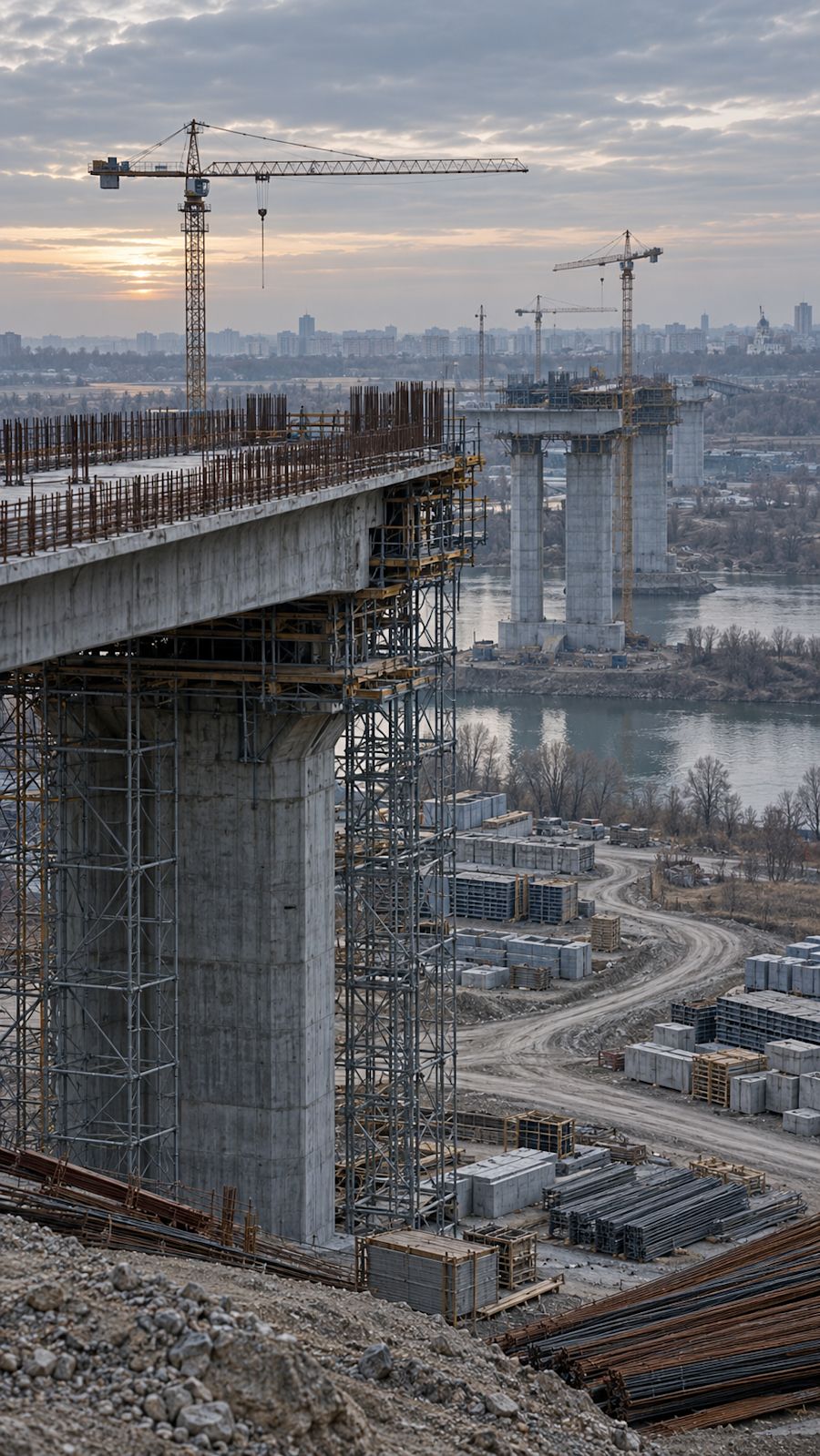
Ukraine's reconstruction bill is now estimated at €500 billion over the next decade, nearly three times the country's projected nominal GDP for 2025. The EU alone cannot cover it and substantial G7 support remains uncertain. That financing gap creates an opening for China, which has the industrial capacity, the capital and the appetite, and has publicly signalled its readiness to take part.
In a new chapter for the EUISS volume Empowering Ukraine, I argue that the goal should be to calibrate China's involvement rather than to prevent it. Read the chapter here.
Beijing's track record in post-conflict reconstruction spans Iraq, South Sudan, Syria, Afghanistan and Ethiopia, and in each case involvement has produced commercial footholds, political leverage and strategic influence. The risks for Ukraine cluster around three threats. Espionage, because Chinese firms operate under a legal framework obliging them to cooperate with state intelligence work, and anything collected could ultimately benefit Moscow. Sabotage, because digital infrastructure and seaports require continuous remote servicing by their manufacturers, and in a conflict that access could be weaponised. And lock-in, because the adoption of Chinese technical standards creates dependencies on Chinese suppliers that are extremely costly to unwind once embedded.
The moment matters. Decisions taken now on procurement rules, technical standards and investment screening will shape Ukraine's infrastructure for decades. The Ukraine Facility Regulation restricts procurement financed under the Facility, but it governs only how EU money is spent — it does not screen Chinese investment financed by Ukraine, other donors or private capital, and contains no investment-screening, high-risk-vendor or foreign-subsidy mechanism.
The EU should therefore equip Ukraine with a protective toolkit before Chinese actors establish footholds: technical assistance on investment-screening methodology, a mechanism modelled on the Foreign Subsidies Regulation to scrutinise state-backed bids, non-price criteria in reconstruction procurement, and high-risk-vendor screening together with NIS2-style cybersecurity obligations frontloaded into reform conditionality. Much of this is not discretionary, since cybersecurity and critical-infrastructure rules form part of the acquis. None of it works without institutional capacity, which Ukraine currently lacks at the scale reconstruction will require.
The cost of building this architecture is modest against the alternative. A compromised port, a sabotaged grid or a decade-long technical dependency would far outweigh any short-term procurement savings — especially once Ukraine is a member of the EU.
The partnership beyond Ukraine
Ukraine is not the only arena in which the limits of the Moscow-Beijing partnership are being tested. I convene and moderate the CHERN China-Russia Talks, a series of public online roundtables examining how the relationship is evolving across different regions of the world.
The first session, China and Russia in the Arctic – partners or rivals?, took place on 24 April 2026 with Rush Doshi (Council on Foreign Relations), Marc Lanteigne (UiT – The Arctic University of Norway) and Minna Ålander (SCEEUS and Chatham House). A recording is available on the event page.
The second, Russia-China Dynamics in the Middle East, followed on 22 July 2026 with Alexander Gabuev (Carnegie Russia Eurasia Center), Andrea Ghiselli (University of Exeter and ChinaMed Project) and Galia Lavi (Israel-China Policy Center, INSS). Further instalments will follow.
In the media
I have discussed these questions with a number of outlets. Radio Free Europe examined Ukraine's own reliance on Chinese components in drone production; the Süddeutsche Zeitung drew on our data story to trace how Chinese trade sustains Russia's war chest. I also spoke to The Diplomat about Western reluctance to price Beijing's backing of Moscow, to United24 on the asymmetry of the relationship, to Newsweek on Putin's narrowing options, and to BFM on Russia's growing dependence on China in artificial intelligence.