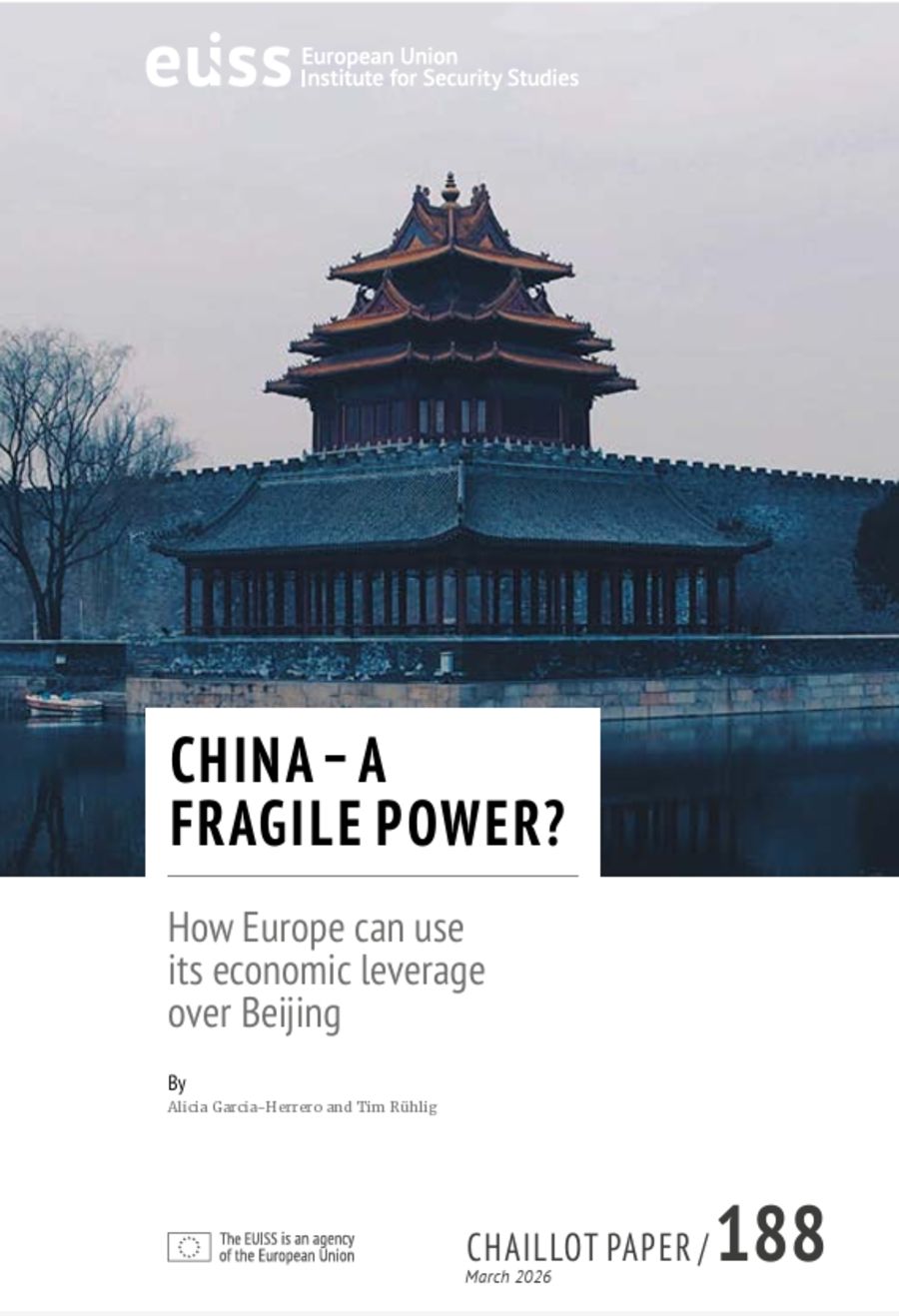


China - A fragile power? How Europe can use its economic leverage over Beijing
China is powerful - but increasingly fragile. Beijing's economic vulnerabilities create both risks and leverage for Europe. How the EU can use its economic strengths to pursue a strategy of leverage-based diplomacy.
Download the full report here.
Europe’s China debate often starts from a single premise: Beijing is strong, increasingly dominant and inexorably rising while Europe must defend itself from a reactive position. A new report by the European Union Institute for Security Studies challenges that assumption.
China is undoubtedly powerful. But it is also increasingly fragile, and that fragility gives Europe leverage, I argue with Alicia García-Herrero and in ‘China - A fragile power? How Europe can use its economic leverage over China’.
Officially, China’s economy grew by 5% in 2025 but it was mostly driven by exports with a stubbornly weak domestic demand. Growth will slow down to below 2.5% in less than 10 years and around 1% after 2035 when China completes its urbanisation process and depopulation hits the labour supply in the cities. Demographic decline, a collapsed real estate sector, weak household consumption and growing global protectionism are eroding the foundations of China’s old growth model. The Chinese Communist Party is concerned that growing societal pessimism, youth unemployment and record-low consumer confidence could erode social stability.
This vulnerability has two consequences for Europe: it creates leverage, but it also increases the risks of retaliation.
The EU accounts for roughly 15% of China’s exports. Even more importantly, Beijing needs access to its high-purchasing-power single market. China also benefits from European technology, research cooperation and high-end industrial inputs, even as it pursues greater self-reliance.
At the same time, Europe’s use of its leverage will likely lead Beijing to retaliate forcefully if the EU decided to use its leverage. China is determined to subsidise domestic industrial manufacturing at all costs. Insufficient domestic demand leads to the export of overcapacities, the distortion of global prices and accelerating deindustrialisation in Europe. China will do anything it can to maintain access to the single market and deter Europe from closing it down.
To divert attention from domestic challenges, China has also doubled down on nationalism and assertiveness. The risk of escalation in East Asia is rising - and this would also carry consequences for the EU.
Despite these risks, we call on the EU to shift towards ‘leverage-based diplomacy’: using Europe’s strengths to make realistic yet substantial demands on China. Europe needs to understand that the cost of inaction is likely going to be higher than the cost of retaliation. If the EU does not defend itself, the risks of a European deindustrialisation will only increase.
Instead of reacting defensively, the EU should:
Preserve and build technological chokepoints to maintain reverse dependencies in areas such as semiconductor manufacturing equipment or high-end industrial machine tools, including targeted industrial policy and protective export controls in key dual-use sectors.
Make diversification - not reshoring - the default de-risking strategy: rather than relying primarily on ‘buy European’ policies, encourage European firms to invest in third countries, especially in the Plural South, to diversify supply chains and export markets. Use sectoral investment agreements, Global Gateway funding and faster conclusion of trade agreements (e.g. with India, Indonesia or Mercosur countries) as well as public procurement rules and tax incentives to reduce exposure to dependencies on Chinese imports, including in sectors such as generic pharmaceuticals, batteries and clean technologies.
Establish credible escalation control: reform the Anti-Coercion Instrument so that a qualified majority of Member States is needed to block - not approve - its activation. This would signal the EU is ready to respond to retaliation.
Use leverage-based diplomacy and condition access to the single market and advanced technologies on concrete concessions from Beijing, such as granting the approval of comprehensive general licenses for rare earth mineral imports from the EU, allowing for the monitor the bilateral real exchange rate between the euro and the RMB and taking remedial measures, and – as a first step – stopping the reexport of European-made dual-use items to Russia before more comprehensive export restrictions are agreed.
At a time of intensifying geopolitical rivalry, the report urges Europe to move beyond the narrative of China’s unstoppable strength. It calls for a more proactive strategy rooted in Europe’s economic strengths - one that ensures Beijing finally takes Europe seriously.